In simple terms, humm is an easy alternative to paying with cash or with credit card and allows you to pay in monthly instalments.
humm allows you to spread the cost of your treatment at Optilase Eye Clinic. It’s that simple. Applications can be made online (please ensure that you are not using Internet Explorer). If you are approved for finance with humm, you can use this approval for any treatment at Optilase Eye Clinic.
*Interest rates and fees are dependent on your plan.
To be eligible for humm you must meet the following criteria:
• Be at least 18 years of age • Provide proof of address • Be a British or Irish citizen or permanent resident in the UK • Earn a minimum taxable income of €1,000 per month • Have a current credit/debit card and a photo ID • Have a good credit history
Padraig Walsh, top hurler for Kilkenny, recently received PRK treatment here at Optilase. PRK treatment combats the common conditions short sightedness (myopia), long sightedness (hyperopia) and astigmatism (irregular corneal shape).
Star Treatment for Kilkenny Hurler
As a Hurling Star Padraig Walsh knew laser eye surgery could make a difference, not only to his daily life but to his game too.
Ian O'Riordan of The Irish Times recently interviewed Padraig about the upcoming Allianz Hurling League. Padraig Walsh had been wearing glasses since his teenage years and now 24, post-surgery has already noticed in his hurling. Padraig confirms "I got the surgery before Christmas and I think it's definitely made a difference, already!"
PRK can often be the best option for sports people due to the nature of how the procedure is performed and the eye heals. It is also the best choice for people under 40. This simple procedure is followed up by wearing a specialist contact lens for five short days, giving the eye time to heal and adjust.
The Future of his Game
Padraig is looking ahead to his games for Kilkenny with optimism, "With the upcoming All-Ireland Senior Hurling Championship, not wearing contacts has really upped my confidence playing Hurling for Kilkenny and I couldn’t be happier with the results from Optilase. I am so glad I had laser eye surgery treatment with Optilase, it has improved my vision and my game so much."
nbsp;
The Price of Perfect Vision
Many sports people, including Tiger Woods, Brian O'Driscoll and Rory McIlroy has had Laser Eye Surgery to better their game. Standard Laser Eye Surgery treatment is available from €795 per eye.
If Laser Eye Surgery could help your game why not avail of a FREE consultation with one of our Laser Optometrists?
Call us today on +353 1 223 8821 or fill out the contact form on this page.
There are few indicators of romantic interest quite as reliable as the eyes. When we’re face to face with someone who sets our pulse racing, there’s no hiding the attraction. From dilated pupils to fluttering eyelashes to raised eyebrows, the signs are visible if you pay attention. Cher once sang, ‘If you wanna know if he loves you so, it’s in his kiss’ but we’re here to tell Cher, it’s all in the eyes!
/* */
When it comes to laser eye surgery, the two most common concerns of prospective laser eye surgery patients are cost and safety; how much will it cost and what exactly is involved in the process from start to finish?
But that’s hardly surprising really because, when you think about it, anyone considering undergoing a life-altering procedure such as laser eye surgery needs to have complete confidence in the provider whom they ultimately decide to go with. In other words, they need to be safe in the knowledge that they are getting exactly what they are paying for, in terms of patient care, customer service, medical expertise and post-operative attention.
And this means that the two big concerns of price and safety are intertwined; you can’t consider one without the other because cost takes into account the entire process from initial consultation right through to post-operative care. Or at least, it should.
Pricing of laser eye surgery at other clinics
It’s a pertinent question and in truth, there simply shouldn’t be big price disparities between one clinic and another. Why? Because at the end of the day, laser eye surgery is a highly sophisticated medical procedure involving the most complex organ in the human body and should never, therefore, be one which is available “on the cheap”.
On the contrary, it should be considered in the context of the entire procedure, from initial consultation through to the laser surgery treatment itself and right through to post-operative check-ups and patient care. Clinics who do choose to drive down prices in order to entice in patients have to cut corners to justify their low cost pricing model: less consultations, less patient care, lower end technology and an all-round inferior treatment from start to finish.
So, if you choose to pay less in the short-term, by taking a chance on a clinic that offers an on-the face-of-it exceptionally low price, the chances are you will simply end up paying more in the long term….because there’s always a catch isn’t there?
Don’t take any risks – your eyes are just too important
As one of the first private laser eye surgery clinics to be set up in Ireland, and with over 40,000 successful laser eye surgery procedures completed to date, Optilase Clinic will always deliver the best possible laser eye surgery treatment imaginable, from the time of your first consultation with our Opthalmic surgeon, right through to your extensive post-operative care.
You see, we don’t cut corners. We deliver the same high level of care to all of our patients every single time – no add-ons, no optional extras, no hidden costs, just exceptional care every time as standard.
So, with our standard laser treatment available from €795 per eye, what you see is what you get; nothing hidden, just top quality patient care delivered in a state of the art clinic environment. And we are so confident in the treatment we offer that we even offer a free lifetime care guarantee to all of our patients so that in the event of any deterioration or issues with your eyesight following laser eye surgery, we will provide enhancement surgery for free with no time limits or expiration dates.
Most people notice they have to hold printed material at arm’s length, away from their face, in an attempt to see it clearly - this is a dead giveaway for Presbyopia. It doesn’t matter if you’ve had laser eye surgery before, or if you’ve had perfect vision all your life - Presbyopia is inevitable.
Are you suitable for laser eye surgery?
If you are interested in finding out more about laser eye surgery then why not avail of a FREE consultation with one of our Laser Optometrists?
Call us today on +353 1 223 8821 or fill out the contact form on this page.
Tom Dunne, Radio Broadcaster and Musician, has undertaken a pioneering treatment called Presbia that provides a reading glasses-free alternative for ageing eyes.
About Tom Dunne
Tom Dunne is a Radio Broadcaster and Musician. He is best known as lead singer with Dublin group "Something Happens" with unforgettable singles like 'Parachute’.
Choosing Laser Eye Surgery
“I lost my ability to see things up close, and became completely reliant on reading glasses”, says Tom. I couldn’t read my phone or the daily papers, which is a big issue in my line of work.”
Tom was experiencing an eye problem that happens to just about everybody over the age of 40: it’s ageing of the eye, known as Presbyopia. The muscles that usually squeeze the lens in the eye into shape, to allow you to see objects close up, become stiff and don’t work as well anymore.
Most people notice they have to hold printed material at arm’s length, away from their face, in an attempt to see it clearly - this is a dead giveaway for Presbyopia. It doesn’t matter if you’ve had laser eye surgery before, or if you’ve had perfect vision all your life - Presbyopia is inevitable.
Life changing treatment with Presbia at Optilase
Tom’s work in media meant he had no choice but to rely on her glasses to see, so he decided to have the Presbia treatment in Optilase.
A microscopically thin disc is slipped into place over the cornea, and it works to gather all the light entering the eye; focusing it onto the retina to allow you to form a perfectly clear image. It only needs to be inserted into one eye, and your distance vision remains unaffected.
“I was excited to hear Optilase had a solution to my near vision problem” says Tom. “The team were explained everything in detail during my consultation and I felt nothing other than a slight pressure during the procedure It’s also really quick. Now I can read my iPad; texts; computer; the newspaper apps on the phone, everything. This small, simple treatment has made a massive difference in my life.
Are you suitable for laser eye surgery?
If you are interested in finding out more about laser eye surgery then why not avail of a FREE consultation with one of our Laser Optometrists?
At absolutely no cost to you, one of our team will carry out a full eye health exam and assess whether you are a suitable candidate for laser eye surgery.
Call us today on +353 1 223 8821 or fill out the contact form on this page.
You never tend to think too much about your eyes when you are not experiencing any problems and in fact, like many of us, you probably just take them for granted provided you don’t see any noticeable or obvious changes in your vision.
But, did you know that in order to ensure you maintain healthy eye function, it is recommended that you should have a full eye check up at least every two years?
Yep, that’s right. It might seem like a chore and you’re probably already thinking that your eyes are perfectly fine, but actually a regular check-up can do one of two things:
Firstly, it will ensure that your eyes remain in perfect health. This is vital because, despite what you may think about your own eyes being perfect, some eye conditions such as glaucoma are actually symptomless and can therefore not be identified without an eye check up. It’s no different than going to a dentist for a teeth check up essentially.
Secondly, a bi-annual check-up is the best way to check for changes to your existing prescription, because a subtle change to your prescription might not be immediately obvious to you.
But apart from having regular check-ups, which seems pretty obvious when you think about, below is Essential Eye Health Advice from Optilase:
Look into your family history!
As with other health problems, some eye conditions are hereditary so you should check to see if there is a history of any eye conditions in your extended family. This of course applies not only to you but also to your children: be vigilant in noticing any eye complaints and ensure that any red flags are addressed as early as possible.
Wear sunglasses
Yes, it’s another obvious point but believe it or not, many people do not wear sunglasses when the sun is shining. And just as your skin needs protection in the form of sunscreen, your eyes too need protection against strong sunlight. Make sure that you buy a pair of sunglasses that have the CE or BS EN 1836:2005mark as that way you will ensure protection against both UVA and UVB rays.
Treat your lenses with respect
You may find that the longer you wear contact lenses for, the less attentive you become when it comes to looking after them and by extension, your eyes. In fact, forgetting to take your contact lenses out in the shower or in bed, for example, can lead to infection and therefore cause serious damage to your eyes. Remember…contact lenses are there to help your eyes but they require some basic daily maintenance and care to enable them to perform for you.
If your eyes are directly at risk by virtue of a dangerous activity, protect them!
Another pretty obvious one for you but again, this is one that many people forget about owing to complacency and carelessness.
So, put very simply, if you are exposing to your eyes to danger (for example, working on a physical task whereby objects are at risk of flying into your eyes), be sensible and wear goggles or a face mask that protects your eyes.
And finally…..stay in good general health and your eyes will benefit too!
Your eyes, like every other part of your body, benefit hugely from you enjoying a healthy, nutritious and balanced diet. Eating green vegetables and ensuring you get plenty of your required daily Vitamins (especially C and E which are great in preventing age related vision problems including cataracts) will help to keep your eyes healthy and well.
Interested in finding out about laser eye surgery?
If you are interested in finding out more about laser eye surgery then why not avail of a FREE consultation with one of our Laser Optometrists?
At absolutely no cost to you, one of our team will carry out a full eye health exam and assess whether you are a suitable candidate for laser eye surgery.
Call us today on +353 1 223 8821 or fill out the contact form on this page.
For anyone considering laser eye surgery, LASIK eye surgery is a term which you will commonly encounter; in fact, wherever you turn, at every stage of your research into laser eye surgery, LASIK will keep on popping up.
So what is LASIK eye surgery exactly and what are the key things to know about it when you are considering undergoing laser eye surgery treatment?
The first thing to know about LASIK!
The first thing to know about LASIK is this: it is the most commonly used laser eye surgery procedure in the world, and actually became the world’s most common elective procedure way back in 2001. This means that for pretty much as long as laser surgery has been around, LASIK has been the leading and preferred laser procedure. (We just wanted to clarify this first off because it’s a pretty important starting point in establishing the predominance of LASIK on a global scale).
But what exactly is LASIK eye surgery?
Now that we have established just how common LASIK laser surgery is around the world, the next question is, what is it exactly?
Well, without stating the obvious, LASIK (the full medical title for which is Laser Assisted In-Situ Keratomileusis) is simply a specific type of laser eye surgery which is used to treat a range of very common vision problems, including nearsightedness, farsightedness and astigmatism.
What happens during the LASIK procedure?
During LASIK surgery, the surgeon uses what is called an “excimer” laser in order to reshape the cornea. So, a thin layer of the cornea is lifted to create a tiny flap on the surface of the cornea, using blade-free Intralase Technology. The laser is then applied to the underlying surface to reshape the cornea, correcting the patient’s prescription. The flap is then simply replaced into exactly the same position as before, and the procedure is complete.
Who can benefit from LASIK laser surgery?
Well because LASIK is by far the most common laser eye surgery procedure, approximately 80% of the adult population is a suitable candidate for LASIK surgery. Many will share the following eye traits:
Aged 18 or over (the reason being that by this age their prescription will have stabilised, making them suitable candidates)
Suffer from one of the three most common vision problems: astigmatism, nearsightedness or far sightedness
Simply do not want to or cannot wear contact lenses or glasses!
Other factors will also be considered, when establishing your suitability for LASIK surgery, including your lifestyle, your overall general health and your previous medical history.
That is why here at Optilase Clinic we offer all potential patients a free consultation with one of our Optometrists, to determine whether laser eye surgery is the right solution for your particular vision needs.
How safe is LASIK eye surgery?
Whilst with any elective surgical procedure there is always some element of risk, the fact is that LASIK eye surgery is one of the most common and certainly one of the safest of all elective surgical procedures.
With LASIK surgery technology now incredibly sophisticated, it is now safer than ever before. Both eyes can be treated on the same day in approximately 5 minutes in total, and patients can expect to be in and out within approximately 2 hours. This highlights just how advanced the surgery now is.
Think of it in the context of this fact: the risk of going blind as a result of laser eye surgery is approximately 1 in 5 million. So, while no elective surgery can 100% guarantee, the risks of any serious, long-term implications are minimal.
How much does LASIK cost?
While the costs of LASIK surgery vary from patient to patient, according to unique patient vision conditions and ailments, the standard LASIK treatment with Optilase starts from just €795 per eye.
But of course with Optilase there are no hidden costs so the cost of your surgery always includes as standard, your free initial consultation, your pre-surgery consultation with your Opthalmic surgeon, the surgery itself and of course the Optilase lifetime care guarantee.
Arrange your free consultation today!
Contact us today to book your free consultation - because the sooner you meet with us, the closer you will be to knowing if you are a suitable candidate for LASIK eye surgery. Call us today on +353 1 223 8821 or fill out the contact form on this page.
As if you weren’t already aware, laser eye surgery is becoming more and more popular with every passing year as people, in ever increasing numbers, are opting to ditch their eyewear by undergoing what is a life changing procedure in just ten minutes!
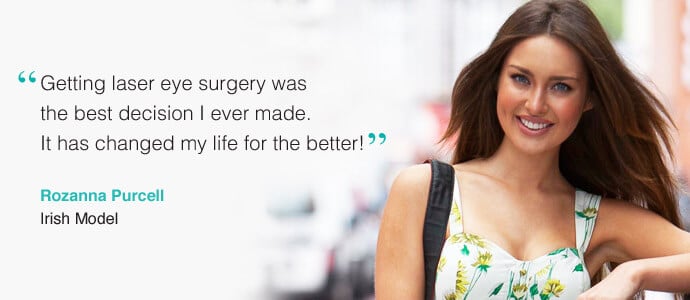
Just ask Brian Maher of Dublin’s 98FM, the latest Irish celebrity (others include rugby player Doug Howlett, model Roz Purcell and hurler Donal Og Cusack) to undergo laser eye surgery with Optilase Clinic.
Just ten minutes is all it takes!
Now we’re not here to tell you how to spend your time but seriously, there aren’t too many important things in life that can be achieved in a tiny little ten minute window, are there?
Take buying glasses for example. How long does it take to choose a new pair of glasses? Might seem simple enough but actually, when you think about it, it’s a pretty time consuming and arduous process: What colour frame? What brand will I go for? What shape suits my face? All of these little considerations are greatly magnified when it comes to the act of actually buying them!
(Let’s just say that if you can pick the perfect pair of glasses at the first time of asking, without having to traipse from shop to shop humming and hawing over which pair suits you best then you’re definitely in the minority!)
Once you know the facts, laser eye surgery is an easy choice
People who wear glasses by and large tend to do so for many years. Because of this, they simply become accustomed to wearing them; their glasses become part of who they are and part of their physical appearance.
This is why it can take many glasses wearers a period of years to consider what it might be like to not have to wear glasses, and to finally come to the realisation that actually there is no reason why they even have to wear glasses at all, thanks to laser eye surgery.
Brian Maher’s laser eye surgery journey
Brian Maher was very much of this school of thought, until hey presto, that light bulb moment finally dawned - ie that moment when he finally wondered why he was still wearing glasses at all when there existed a simple ten minute procedure which could give make him glasses free and give him perfect vision!
Of course initially, Brian had the same fears and concerns that everyone has prior to undergoing laser eye surgery: Will it hurt? Will it work? Will my eyes be perfect afterwards? What if something goes wrong?
These are all completely natural and perfectly legitimate concerns to have and that’s why we offer a free consultation which allows us to meet with you to address all of your concerns and issues, prior to deciding whether to proceed.
"Afterwards, I was able to look down the street and see people’s faces that I would never normally be able to do without my glasses, it was just such an amazing moment!"
Once Brian met with one of our specialist Laser Optometrists as well as our Opthalmic Surgeon prior to his laser surgery being scheduled, he was surprised (and of course delighted) that all of his initial fears and worries disappeared as a result of being addressed.
The reason for this lies in our open and honest approach that we take to dealing with our patients; we know how big a decision it is to go for laser eye surgery so we go to great lengths to explain absolutely everything you ever need to know about what is involved.
We separate the facts from the myths and in doing so, give you the tools to make an informed decision that you will be happy with, one way or the other.
Another success – another person with perfect vision!
At Optilase, we are 100% patient focused – and that means that we are only happy when our patients report back that their lives have been transformed as a result of laser eye surgery! And thankfully, 98 fm’s Brian Maher is another patient who is delighted that he took the step to have laser eye surgery… for the reasons outlined below!
1. Perfect vision
Brian Maher: “I’ve had perfect vision for over a year and a half after going to Optilase”.
2. Able to read car things like car registrations!
Brian Maher: “I remember afterwards just stepping outside and being able to see car registrations straight away, I was able to look down the street and see people’s faces that I would never normally be able to do without my glasses, it was just such an amazing moment!”
3. Some of his friends have even had it done since!
Brian Maher: “If someone was going to have laser eye surgery I couldn’t speak highly enough of it. I would tell them to have it straight away. In fact, a good few friends of mine have had it done since!”.
Book your free consultation today!
Call us today on +353 1 223 8821 to arrange a FREE consultation with one of our Laser Optometrists. Not only will they carry out an extensive eye examination and answer all of your questions, they will also explain in detail the various options that are open to you, on the basis of your precise vision needs.
Most of us will recall that very often, as a child, our parents would holler at us to “move back from that television or you’ll get square eyes!”. (Does this ring any bells or was it just me!?)
Of course, as a child you don’t question the fact that it is not physically possible to ever get square eyes but I guess this term was not designed to be taken literally! Translating it, what parents were really saying was simply that sitting too close to the television was bad for your vision and could result in damage being caused to your eyes.
As it turns out though, our parents were wrong all along - or were they perhaps just guilty of telling us little white lies to stop us watching television?
Whatever their reasons, the fact of the matter is that a new report, published in the US, finds no evidence at all to show that close up activities such as frequent reading or sitting too close to the television can bring on myopia, or near-sightedness. But what it does intriguingly find is that it is now possible to predict the onset of myopia in children.
What is myopia, exactly?
Myopia is the medical term for near-sightedness. It is one of the eye conditions that come under the heading of Refractive Errors.
Refraction is the bending of light, and this is what the cornea (the clear part at the front of the eye) does to the light that enters the eye. The spherical cornea is supposed to bend light evenly so that it hits one single point on the retina at the back of the eye to form a sharp image.
However, many people have irregularly shaped corneas, which do not bend or refract light evenly, so they have trouble forming a clear image. Essentially, because the light gets focused in front of the cornea rather than directly on it, objects that are far away appear to be blurry.
How is myopia treated?
Thankfully, myopia can now be easily, painlessly and very quickly corrected through laser eye surgery. Laser eye surgery will simply reshape the cornea, allowing light to focus on the retina so that you can once again form a sharp image, without having to rely on corrective eyewear.
Essentially, what we’re saying is that, instead of having to wear glasses or contact lenses to adapt your vision to cope with your myopia, a simple 10 minute laser eye surgery procedure can completely correct this problem for you.
The onset of myopia in children – the report’s findings
The College of Optometry at the Ohio State University, first commenced its study into the onset of myopia (near sightedness) in children, and the underlying causes of myopia, 20 years ago way back in September 1989.
The objective of the study was simply “to determine the best set of predictors for myopia onset in school aged children”.
With this in mind, data was collected from 4,512 ethnically diverse, non- myopic school aged children from grades 1 through to 8.
The result of this study is truly ground-breaking by virtue of the fact that it has now identified a single test that can predict which kids will become near-sighted by eighth grade.
And that test is simply this: that future myopia can be predicted in a non-myopic child using a single measure of refractive error.
The main outcome and measures
The study evaluated 13 potential risk factors for near-sightedness, in order to determine the strongest single predictor or set of predictors that could identify those children most likely to develop myopia; these included physical measurements of the eye, as well as reports from parents about their children's activities.
Of these 13 potential risk factors, the report determined that 8 of these did actually increase the likelihood of kids developing the onset of myopia / near-sightedness.
One important risk factor established was having two near-sighted parents but equally, the most surprising and notable exception from risk factors were activities that involved near-work (close up activities such as reading and watching television).
Refractive error measurement
In people with myopia, what happens is that the typically spherical eyeball in fact becomes oval shaped which therefore distorts the vision.
However, the finding of this study clearly shows that kids who will grow up with normal vision are actually slightly far-sighted when they are in first grade. This means that the potential for future myopia can be detected at this very young age via a refractive error measure that reveals little to no far-sightedness.
So in real terms then, the findings of this report clearly show that a 6-year-old child with less far-sightedness is at a higher risk of developing myopia sooner.
And furthermore, if every child was to have an examination before starting school, refractive error could be assessed which would help to predict whether a child will at some point develop myopia.
70% of Irish consider our society ageist and 1-in-5 also believe they’re “invisible” to younger Irish adults, according to Optilase.
Majority of Irish judge ageing based on appearance
Over 45’s consider their skin, hair, body weight and eyesight as biggest ageing issues
Irish dodge reading glasses for years out of vanity
Almost a quarter feel it’s hard see their body changing and can make them feel a bit ‘lost’
More than 1-in-5 (22%) of adults over 45 also believe they are starting to be “looked through” as though invisible, by younger Irish
70% of Irish consider our society ageist
31 March 2015: According to new research from Optilase, Ireland’s leading laser eye surgery clinic, the vast majority of Irish (91%) judge a person’s appearance as the main reason to consider them ‘middle aged’.
Over half (53%) of Irish focus on facial looks, while almost 1 in 5 (18%) cite quality of hair with the same proportion citing body appearance. Only a fraction of Irish (4%) believe a person’s clothing can make the difference and even fewer (3%) believe non-appearance led changes to mental agility or physical mobility define the ageing process.
Most Irish people over 45 have also considered what makes them look older than they used to. Almost 1-in-5 consider changes to their skin as the number one issue, while almost 1-in-4 cite weight gain and almost 3 in 10 rated a change in hair (going grey, thinning etc.).
Wearing reading glasses was also seen as an ageing factor for many Irish people. Over 4 in 10 regard this as one of their biggest worries about getting older and more than 1-in-10 felt this was the number one sign to others that they are middle aged. In addition, almost 1-in- 6 considered it the second biggest issue, after skin, hair or body weight. When asked to rank how they feel about wearing glasses almost half (48%) put unglamorous in their top three factors, while almost two thirds (63%) had making them feel older and middle aged in their top three.
Unsurprisingly then, almost a third (29%) of Irish resist purchasing reading glasses and 1-in-10 spend years dodging the need to wear them. The ways we dodge them are quite creative. In restaurants, more than 1-in-10 (16%) Irish squint at menus under candlelight or order dishes they’re familiar with, while other tactics include borrowing other people’s glasses for short periods of time, and waiting until people are standing right beside us before we can confidently address them.
As a result, over half (55%) of adults over 45 struggle with their sight. Almost one in three (32%) can’t read labels, 14% have issues reading signs and almost 1-in-10 (9%) struggle to read digital devices.
So why do we put ourselves through this hassle, for the sake of our appearance?
Over half of all Irish (55%) feel that signs of aging made them feel less like themselves
Almost a quarter of Irish feel it’s hard see their body changing and can make them feel a bit ‘lost’
Almost a third (31%) say it bothers them that they don’t look as good anymore on a night out
More than 1-in-5 (22%) of adults over 45 also believe they are starting to be “looked through” as though invisible, by younger Irish. And while over half (54%) say they’re not bothered by this, almost 1-in-4 admit that it has made them feel sad, while 1-in-10 experienced feelings of being embarrassed. Some of us have also felt angry (7%) and resentful (3%).
This probably accounts for the fact that, while 80% of adults over 45 still do consider themselves to be sexually attractive, more than 1-in-3 (38%) only consider themselves sexually attractive to people of their own age or older. More worryingly still, 1-in-5 (20%) over 45 year olds believe they are past the point of being considered “sexy” to anyone.
Does this mean that our society is ageist? Our attitude to this is complex. Almost 1-in-3 (30%) of us believe Irish society is not at all ageist leaving a resounding 70% that believe it is. Of the 70% who believe our society is ageist, 30% give their first rank to us being inherently ageist while 1 in 20 of us awarded top ranking to Ireland being most ageist when it comes to politics. Over 1-in-10 (13%) gave top rank to the Irish being at its most ageist in business, while 1-in-6 (17%) ranked us most ageist when it comes to dating.
So how do Irish adults over 45 get their mojo back? Over a third (37%) believe that if their skin looked better they would feel more like themselves. While over a quarter (26%) believe that they would feel more like themselves if they had their full vision back and didn’t have to wear glasses. Almost 1-in-4 (23%) believe they could counteract the signs of aging if they could dress like they used to and more than 1-in-5 (21%) would feel more like themselves if their hair was thicker and fuller.
Commenting on the research results, Optilase Medical Director Dr. Wayne Crewe-Brown said: “This research shows that many Irish adults over 45 are holding themselves back because of insecurities about their appearance. In Optilase we use state-of-the-art treatments to restore sight and have seen first-hand what a positive change this can have in the lives of our clients. We’re encouraging more Irish adults to address this confidence issue, by sharing their opinions online with the #VisibleAdult hashtag.”
All figures are from a survey carried out by MRNI Research, conducted using a sample of 220 adults aged 40+ across Ireland (125 females and 95 males) in the 40-65 age group, covering all four provinces of Ireland. Fieldwork for the survey was undertaken from 11-18 March 2015 and was carried out using an on-line methodology.
Just in the past few weeks, legendary actor Dame Judi Dench has revealed that as a result of her failing eyesight caused by an age-related condition known as macular degeneration, she is now unable to travel alone.
Though you may never have thought it, she is now 80 years of age and still working away as an actor at the very highest level of her profession. Now, though you may argue that she is handsomely paid for every movie she makes (and there is no doubting that indeed she is), this still does not make the job any easier in a physical sense; international jet setting is very much part and parcel of the job of being a Hollywood actor, not just an optional little extra so good vision is therefore an absolute requirement of the job.
But even aside from the adverse affect that this vision disease has on her career, it also impacts on her ability to enjoy the simple things in life that she has always enjoyed doing as an artist and as a person; not being able to indulge her painting hobby and even not being able to watch a movie in comfort.
Just imagine for a second how difficult this all must be for Judi Dench both personally as well as in terms of her career as an actor?
Near sightedness affects most people over the age of 40!
Of course, Judi Dench is certainly not unique in developing sight problems as she has aged, and in actual fact almost everybody (well, 1.7bn people globally to be precise!) experiences deteriorating near vision sometime between the ages of 50-65. The technical term for this very common vision ailment is Presbyopia.
In simple terms, Presbyopia is the loss of ability to focus on near objects as the eye ages. Essentially, the lens of the eye stiffens – similar to what happens to our joints as we age – and loses its flexibility, making it very difficult to read close up objects clearly.
This can make our lives very uncomfortable indeed; suddenly, all of those little everyday activities that we took for granted - reading a newspaper, checking a price tag in a shop, reading a text message – become frustratingly difficult simply because our eyes are not what they once were.
And by the way, it doesn’t matter if you have enjoyed 20:20 vision all your life; Presbyopia is just another unpleasant part of the ageing process that affects pretty much everyone at some stage!
Solutions?
For most people, the obvious solution to near vision sight loss is simply to purchase a pair (pairs!) of reading glasses. But you know what happens next...you go to find your glasses and they are not where you thought you left them. Or worse still, they’re crumpled up and broken in your pocket. Because you sat on them. So yes, reading glasses may well help in terms of aiding your vision...the only problem is that they won’t work when you do as per the aforementioned, and will therefore present their own unique problems!
Reading Glasses
For most people, the obvious solution to near vision sight loss is simply to purchase a pair (pairs!) of reading glasses. But you know what happens next...you go to find your glasses and they are not where you thought you left them. Or worse still, they’re crumpled up and broken in your pocket. Because you sat on them. So yes, reading glasses may well help in terms of aiding your vision...the only problem is that they won’t work when you do as per the aforementioned, and will therefore present their own unique problems!
Reading Vision Correction Surgery
Here at Optilase Clinic, we offer two great treatment options, Kamra and Presbia, both of which involve tiny optical inlays, which allow the eyes to accommodate near vision, without need for reading glasses and without loss of distance vision.
Kamra – the inlay used is a tiny ring with an opening in the centre. The inlay narrows the opening that permits light rays to enter the eye and repositions the focal point back onto the surface of the retina, giving clear uninterrupted vision.
Presbia – The small microlens is inserted in the pocket of the cornea of the patient’s non-dominant eye. The pocket seals itself and holds the lens firmly in place, allowing greatly improved vision in just 10 minutes!
If you are over 40 and rely on reading glasses, or cannot see print clearly any longer, book a free consultation to see an experienced Optilase Optometrist for a Reading Vision Correction evaluation. Call us today on +353 1 223 8821 or fill in the form and one of our staff members will be in contact with you as soon as possible.